The Good, the Bad, and the Template: Contrastive Anomaly Detection in 3D
Abstract
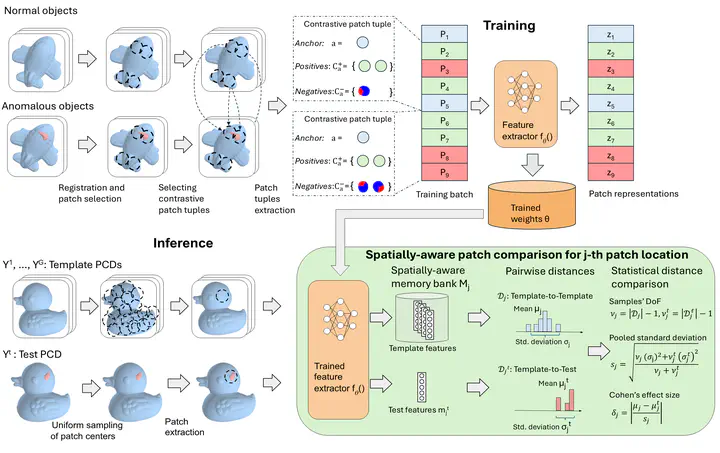
Anomaly detection and localization (ADL) in point clouds is a rapidly expanding field of 3D computer vision, owing to its importance in robotic manufacturing and automated quality control. Recent ADL methods extract representations of 3D geometries from a test object and compare them to representations of anomaly-free objects. Despite rapid progress, modern ADL techniques still struggle to meet accuracy expectations in safety-critical fields such as aerospace. The main challenges are learning representations that are highly robust for anomaly detection and developing algorithms that accurately and unambiguously compare these representations. We overcame the first challenge by formulating ADL as a semi-supervised contrastive learning problem and developing a deep representation extractor optimized for anomaly detection. For the second challenge, we compare test representations with anomaly-free representations of multiple reference objects, precisely aligned in a common 3D reference frame. Our method establishes a new state of the art on Real3D-AD and Anomaly-Shapenet datasets, achieving a mean area under the ROC curve of 91.2% and 94.9%, respectively.